Weekly Review.

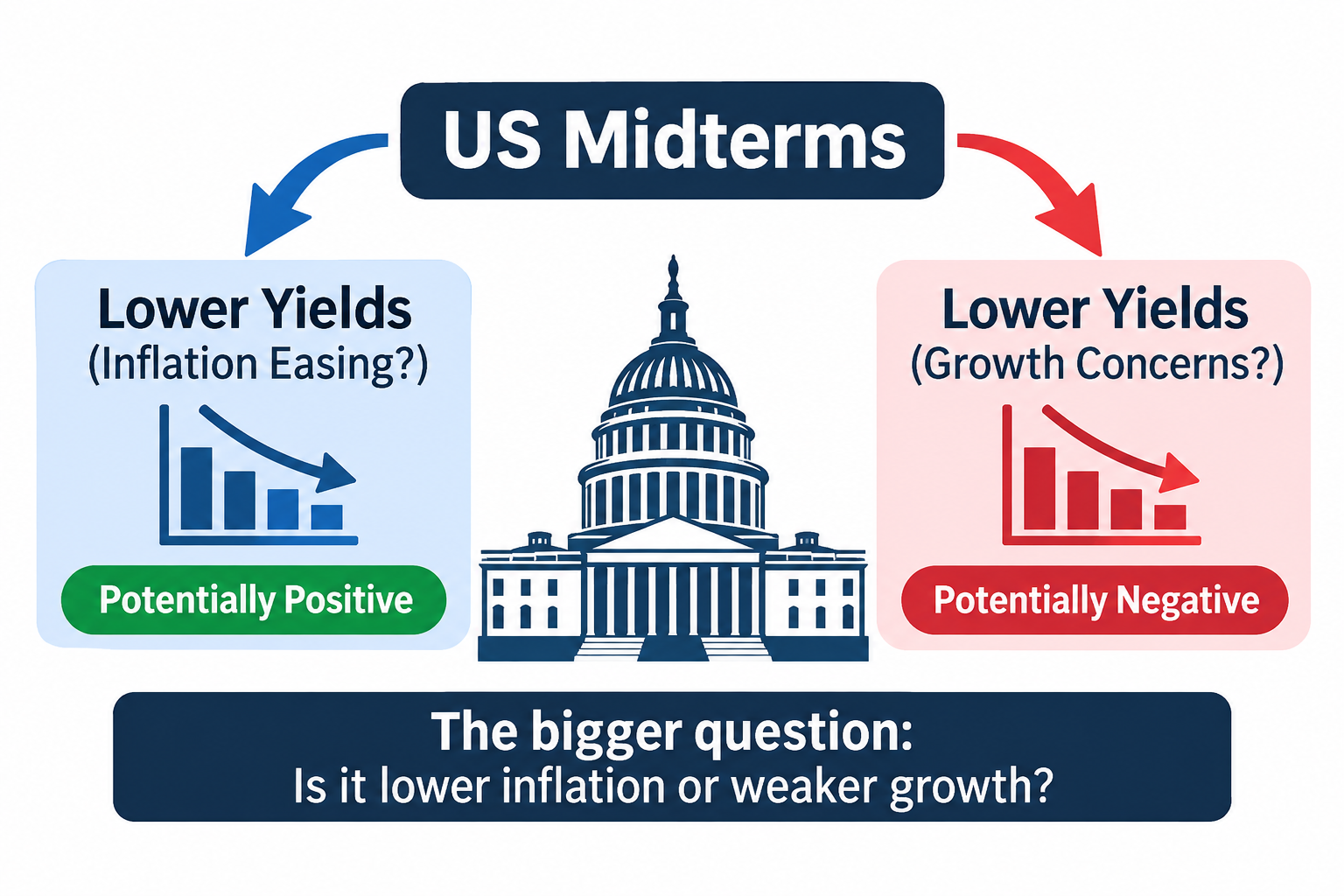
The outcome of the US midterm election gave us plenty of food for thought during the week starting Monday 2 November. A clean sweep for the Democratic party makes it much more difficult for President Trump to implement legislation during the second half of his term. The true implications are far reaching and yet to be determined, with the initial focus on AI and US / IRAN. The hope being that with a bigger influence on proceedings, the democrats will push for a swifter resolution to the US / IRAN war. The AI story isn't quite so straightforward. In a nutshell, the market has been growing increasingly concerned about the cost of AI infrastructure, if the Democratic party push to slow down the AI roll-out, these ‘cost concerns’ are put to one side. On the flip side on the coin, a lot of future growth has been put on the shoulder of AI, therefore, if the AI roll-out slows, growth projections are hit, potentially turning into outright growth concerns. Initially, the market cheered the midterm result, Wednesday's relief rally implied satisfaction, especially pertaining to US / IRAN and AI. But by Thursday, second thoughts crept in, the NASDAQ had it's worst day since 2020, the negativity spilled over into other instruments, with the VIX hitting a multi month high of 28. Whether this was simply company specific profit taking from overcrowded positions, or the beginning of a sustained ‘growth scare period’, is the question we take into the new week. In other news, the RBA hiked rates, it was always going to be difficult for the central bank to maintain an extra hawkish bias. And the market took the neutral hike as a disappointment, the AUD was also not helped by news that China wants to actively de-value the yuan, plus the overall negative environment also weighed on the AUD. Likewise, the NZD came under pressure thanks to soft employment data, China wanting to de-value the yuan and the negative risk environment also weighed on the kiwi. Despite this negativity, if the risk environment turns positive, the AUD and NZD both revert to potential long options. The BOE delivered a rate hike, with quite hawkish narrative. Ordinarily, this would produce a sustained period of strength. But the GBP eventually succumbed to the negative risk environment. Similar to the AUD and NZD, the GBP remains a good long option if overall sentiment returns positive.
During the early part of the week, I was quite surprised the post BOJ strength didn't carry over as the JPY was quite subdued. But the yen reverted to strength during Thursday's risk off move. It was also quite difficult to judge the EUR and the CAD during the early part of the week, I was quite surprised at the EUR resilience as the post ECB bounce continued despite ongoing political uncertainty (on balance, I suspect the path of least resistance for the EUR remains down). The CAD began the week on the front foot, got moved about on mixed war headlines, and ended the week on the back foot following soft employment data. Finally, it was a mixed week for the USD, post midterm weakness was swiftly halted by Friday's NFP beat. It's now all eyes on Tuesdays CPI data for clues on the next few FOMC meetings. I'll begin the new week watching the VIX, and asking why are bond yields doing what they are doing, does it have positive or negative implications? Whilst keeping an eye out for war headlines and anything else that gets thrown our way. On a personal note, it was a week of three trades. Monday's EUR GBP short was closed for a small profit. Tuesday's EUR CAD short stopped out as the CAD moved with oil on war headlines. Arguably, there was a risk off opportunity on Thursday but I missed it. Once NFP had been reported solid accross the board (jobs, unemployment, wage growth) I felt the USD would strengthen into the weekend, the CAD was a clear choice following simultanious soft Canadian jobs data. My USD CAD long hit profit. Let's see what the new week brings. Results: Trade 1: EUR GBP +0.5 Trade 2: EUR CAD -1 Trade 3: USD CAD +1.2 Total = +0.7% Total since start of blog = +77.9% (risking 1% per trade).