I've updated my book.

It only seems like a couple of weeks ago that I finished my book but somehow three years have past. So I've decided to update the book to touch on recent events and anything that has changed in the last three years.
I think anyone reading this has read the original book but if not let me know and I'll send a copy.
At some point I'll upload this extra piece to Amazon and the book should automatically update. But in the meantime, here is the updated extra:
2026 update It's now March 2026 and I've decided to update the book with my current thoughts on the market. Although everything you've just read remains valid, I noted that 2023 was an extremely difficult trading environment. Unfortunately, it hasn't gotten any easier. The important thing to note is that the core principles of the strategy remain exactly the same. But what has changed since I originally completed this book? S&P The S&P 500 was ‘stuck in a range’ and I said it would take something to happen for it to ‘break’ one way or the other. Not long after the book was published, that ‘something’ happened in the form of the AI breakthrough. Sending the index higher. Essentially, Companies at the forefront of AI innovation, such as NVIDIA, MICROSOFT, GOOGLE and META, have seen substantial growth, driving the index to new heights. The breakthrough in AI was a bona fide reason to place ‘risk on’ trades. At the time of writing, the initial ‘AI euphoria’ has somewhat dissipated and the current narrative is one of slight negativity. Confusion over how AI will affect the jobs market and whether companies are spending too much money developing the product is stifling further positivity whilst the S&P sits near all time highs. One thing I will say about AI is that I've started to include it in my quest to understand the day's narrative. I still read all of the websites I've mentioned (FOREX LIVE is now called INVESTING LIVE), currently I find ING and ACTION FOREX particularly useful. But I'd certainly recommend experimenting with AI, asking what it thinks is moving the currencies today. But don't just blindly follow what AI says, similar to any article you read, it's important to take in the information and form your own opinion. Something that is particularly noticeable with the S&P at the moment is ‘erratic movement’ during the first half hour of the American open (09:30 US eastern time). To an extent this has always been the case but it's particularly pronounced at the moment, there is a lot going on in that first 30 minutes of the S&P open, it's definitely worth doing some research (Google or AI) and make up your own mind as to whether to trade through the first 30 minutes of the American open or wait until the choppiness subsides. Personally, I take it on a day by day basis, sometimes the pre-open narrative is so strong I feel like it can be traded through. Sometimes I find it's prudent to wait for the market to find a direction once the open has settled down. The BOJ The bank of Japan and the ‘will they, won't they’ (raise interest rates) was a major cause of a particularly difficult trading period. The BOJ did eventually raise interest rates, bringing the rate above zero and currently at 0.75. But not before a circus of ‘intervention’, verbal and actual in an attempt to strengthen the JPY. The BOJ still remains relatively ‘hawkish’ compared to other central banks. There is still talk the BOJ will raise again but the JPY remains my preferred currency to sell during times of ‘risk on’. We just have to accept bouts of yen strength following ‘rate hike or intervention chatter’. Inflation inflation has gradually decreased over the last couple of years, although still a little higher than central banks would like. The initial inflation shock caused by COVID and the Ukraine war is slowly subsiding as supply chains improved. Although we have had a couple of inflation scares, namely president TRUMPS tariffs and currently, the rising price of oil (caused by military conflict between the US and IRAN). Both narratives have led the market to wonder if inflation will worryingly rise again, causing periods of negativity. Remember how I said the market always focuses on something? As I'm writing this, the ‘oil shock' narrative, caused by the US IRAN military conflict, is gathering steam, the price of oil is 100 and the market is growing increasingly concerned that a fresh bout of inflation could become embedded. Risk off trades are the order of the day at the moment. Mr President Speaking of the president. Mr Trump has taken office since I completed the book. The president has brought a little more volatility to the trading environment than the previous incumbent. Meaning, quite often, sentiment can change from day to day, even from session to session. And these days, I do find myself closing trades before the end of day to guard against changing sentiment. That is probably the biggest change to my trading, it's not every trade, it's a decision taken on a trade by trade basis. It isn't ideal because it skews the 1.5:1 mathematics but it's something I feel is necessary for the time being whilst we navigate the changeable environment. CHF Throughout my trading career, I've had periods when I've traded the CHF and periods I've taken it off the roster. Historically the SNB has overtly intervened when the Franc’s movement doesn't suit the bank's narrative. This de-correlates the CHF from its natural risk environment correlation. There was also a renowned incident in 2015 when the SNB ‘removed the EUR CHF floor’. If you're unaware, it's worth doing some brief research on the incident before coming to your own conclusion as to whether you're comfortable trading the CHF. But ever since central banks have started the ‘post COVID rate cut cycle’, the CHF very often behaves according to the risk environment. And it's currently ‘on the roster’, especially in a ‘risk on’ environment because the SNB overtly prefers a weaker currency. It's just that, similar to the JPY, intervention or un-correlated movement becomes a risk to the trade. But if I'm comfortable trading the JPY with an intervention risk, I'm currently ok trading the CHF. Timeframe Throughout the book, I endorsed ‘higher timeframes,’ specifically when placing a stop loss. I very strongly stand by my preference of trading 1hr and 4hr timeframes. The problem is, during this moment of ‘session by session narrative change’, you can't place a trade and expect the narrative to still be in play 36 hours later. Which means placing a stop loss behind a 4hr or 1hr swing is hard to come by. Currently, if I solely waited for 4hr or 1hr swings (my absolute favourite is ‘a cluster of 1hr swings), my guess is that I would be placing about three trades a month. Which is fine if I'm prepared to risk 5% per trade, but I'm not, I still strongly suggest risking between 1% / 2.5%, because of the potential psychological damage it could do seeing your account instantly drop by 5% but also, keeping on top of the narrative on a daily basis is an immersive experience and I think I would get frustrated and bored if I was doing all that reading everyday but only placing one trade every two weeks. In an attempt to continue placing 2 / 3 trades per week in a session by session, changeable environment, I've been forced to accept I must go to a lower timeframe with the aim of the trade completing within 12 hours. It isn't my preferred choice but it's an example of having to flow with the times. Currently, I'm placing ‘standard trades’ on 30min charts, sometimes 15min, I quite like ‘a cluster’ of 15min support to place a stop loss behind when a chart aligns with the underlying narrative. Here is an example of a trade I recently placed, on Tuesday 10 March 2026. Narrative: For the past couple of weeks, military conflict between the US and IRAN has been the dominant theme, which has understandably created a negative environment. But on Monday, President Trump suggested the war would be over very soon, simultaneously, it has been announced that oil reserves will be released in an attempt to bring down the price of oil. These two pieces of news created a ‘risk on’ environment. On Tuesday, as the US session got underway the positive sentiment continued and I placed this AUD CHF long trade:
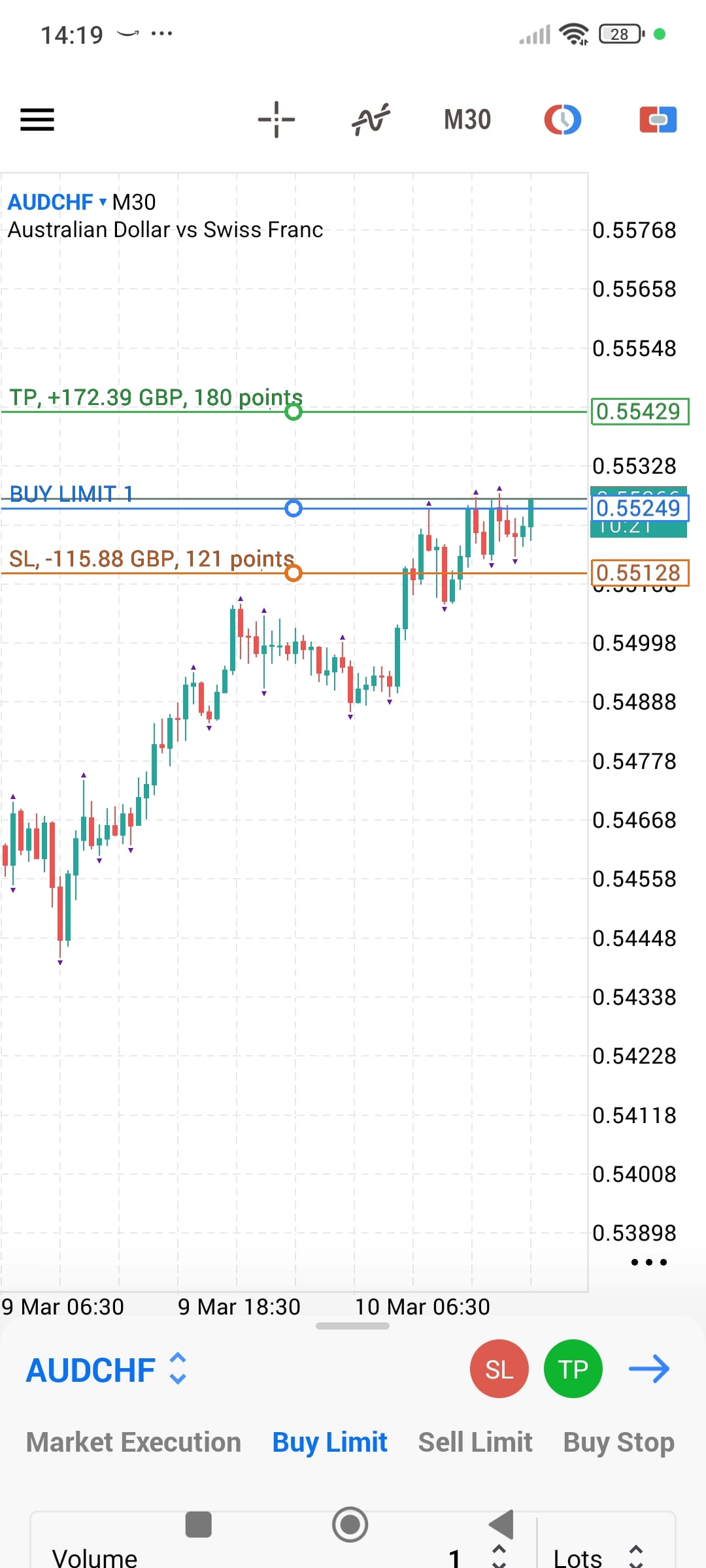
At the time, a 1hr swing hadn't formed but I was comfortable placing a stop loss behind the 30min swings. Here is another example, this time on Friday 13 March 2026. Narrative: By Wednesday, the positivity started to fade as the market began to realise a quick conclusion might be wishful thinking, particularly regarding the passage of oil through the Hormuz strait, If oil can't get through, the price will continue to rise, causing inflation concerns and the ‘risk off’ mood quickly returned. By Friday, the mood was still sour and we also got BOJ intervention threats. Which all added up to me thinking a ‘risk off trade’ was viable to end the week, I placed a AUD JPY short.
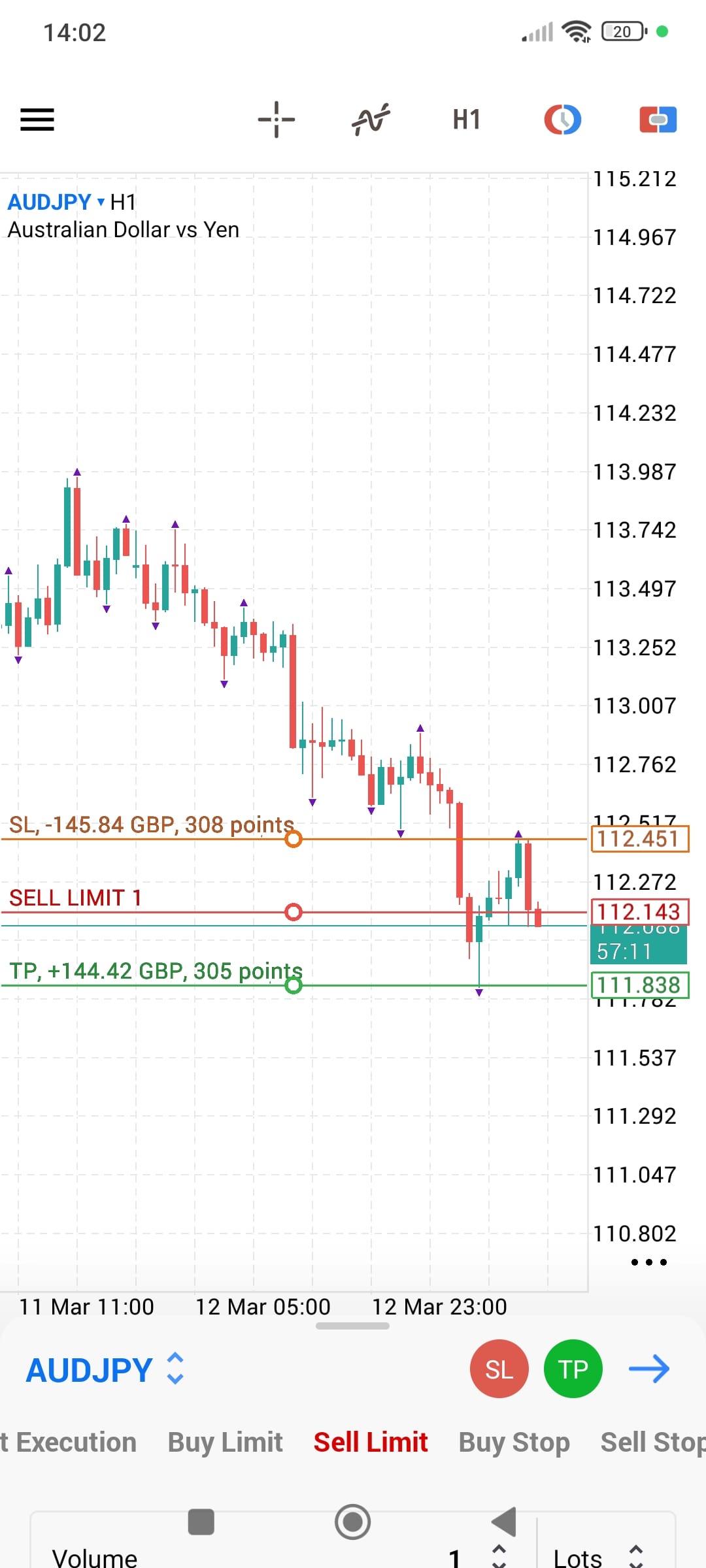
Again, you'll notice the 1hr swing hadn't completed but there was a strong 15min swing and I felt the mood was sour enough for the ‘risk off environment’ to continue into the weekend. Notice how this trade was a 1:1 risk / reward, which I usually do if I trade on a Friday. This trade also shows how the overall market risk environment can still dominate the underlying fundamentals of each currency. At the time of writing, the AUD is the currency that has the most going for it from a fundamental perspective, but it still weakens considerably in a ‘risk off environment’. The two trades above are an example of the current changeable narrative, ‘risk on’ on Tuesday and back to ‘risk off’ by Thursday, it could well be that we are ‘risk on’ again by Monday. It has been like that for a while, often changing on a daily basis. The two trades are also an example of a ‘standard trade’ but placed using a shorter timeframe stop loss than my preferred 1hr. It's currently a case of being nimble, I'm prepared to trade in either direction and I'm prepared to go to a lower timeframe in an attempt at the trade closing quicker. The very important thing to remember is, the trade must be backed up by a strong narrative. If you're placing trades with stop loss behind a 15min swing without a strong narrative behind the trade…the market will very quickly punish you. The FED. From a post COVID high of 5.5% the FED has gradually lowered interest rates to 3.75% at the time of writing. With more cuts on the agenda. There will be a new FED chair from May 2026 and the market will be watching to see if the current projection of another one or two cuts in 2026 are likely. How quickly they come or whether the cuts come at all will go a long way to determining the medium term risk environment. Currently, company earnings remain very positive, the jobs market is holding steady and inflation is gradually falling, the ‘soft landing narrative’ is still in play. The biggest risk to the soft landing scenario is how long the strait of Hormuz situation goes on for. If it continues for months rather than weeks, rising inflation could become entrenched and we'll get the: Yields up + Stocks down = Risk off scenario. But hopefully not. Hopefully, as with every period of negativity the market has recently had thrown at it, the negativity will pass and we'll soon be back to a sustained period of ‘risk on’. Time will tell. Final thoughts One final thing I'll say about AI is that I'm currently experimenting to see if I can collaborate with it to squeeze an extra few percent profit per year. It's a laborious process but so far the signs are quite encouraging. Although I will say that AI may be able to help us come up with a strategy, I still think human intuition will have the final say if there is a trade or not. And I'm positive that a core understanding of geopolitical and economical fundamentals will always be required. That brings us up to date, if anything, the recent changeable environment shows just how important it is to place trades backed up by a fundamental cause. I recently heard a line that I think is quite good: Price is the result, narrative is the cause. I hope this book helps you learn to track the narrative of the day. Most important of all, remember to focus on the decision, not the outcome. Don't worry about profit or loss, just focus on making a good decision. Thank you again for reading this book, all reviews are gratefully received. best wishes John